
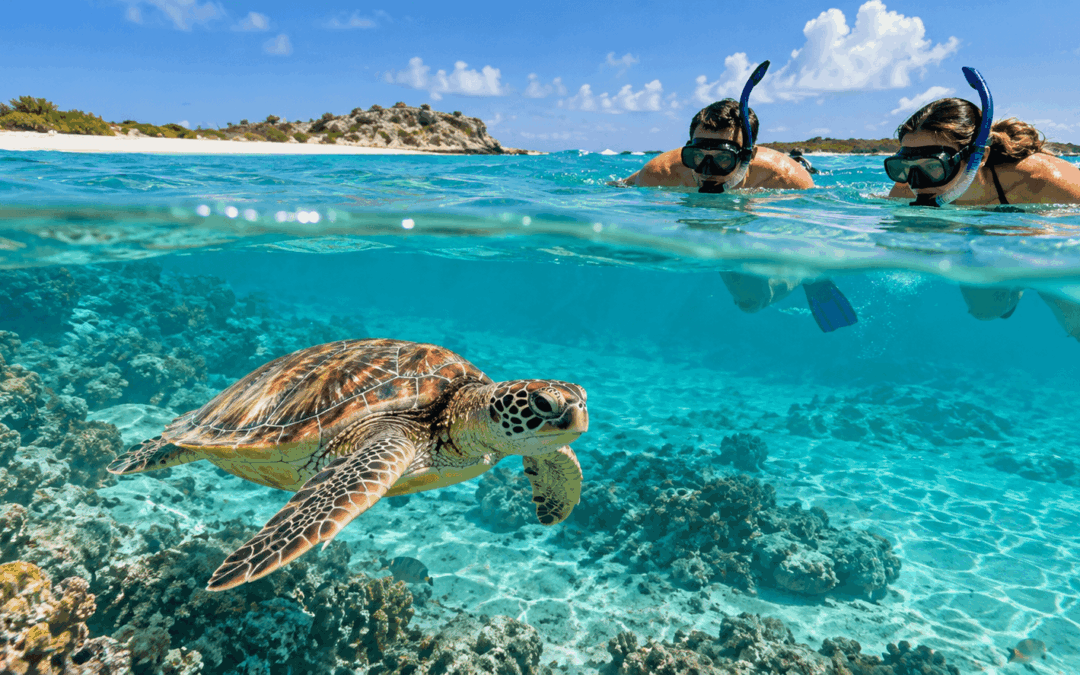
The best snorkeling in Turks and Caicos is on the barrier reef off Providenciales, at Bight Reef and Smith’s Reef from shore, and at Leeward Reef, Pine Cay and Fort George Cay by boat. Water is typically calm and clear, 15 to 25 feet deep on most reef sites, with turtles, rays, parrotfish and reef sharks.
Snorkeling here can be excellent or forgettable, and the difference is where you go and how you get there. The best reef is a mile offshore. The best sandbars move with the tide. The most interesting sites sit behind cays you can’t reach by car.
We run snorkeling charters out of Turtle Cove Marina every day of the season, so this guide covers what we see and where we take guests: sites you can reach on your own, sites that need a boat, what you’ll see, and how to choose.
How does snorkeling work in Turks and Caicos?
Turks and Caicos sits on top of one of the largest barrier reef systems in the tropical Atlantic. Along the north shore of Providenciales, that reef runs roughly a mile offshore. Between the reef and the beach is a wide shallow bank of sand and seagrass, which is why the water is that unbelievable turquoise.
That geography shapes everything about snorkeling here:
- Some of the best reef is not within wading distance. Grace Bay Beach is famous, but the swimming there is mostly sand. The healthy reef is out on the barrier.
- Depth is friendly. Most popular snorkel sites are in roughly 15 to 25 feet of water, which is comfortable for beginners.
- Conditions change by side of the island. The north shore is usually protected and calm. The west coast is more exposed to swell because of the deep water close by.
- Tide and wind matter more than the calendar. A good captain reads both and picks the site that’s clear that day.
When is the best time to snorkel in Turks and Caicos?
There’s no bad month. The water is warm year-round and visibility is generally excellent. What changes is the crowd and the conditions:
- December to mid-February and March: peak season. Calm, dry weather in most years, and the busiest months on the reef and on the water.
- April to June: quieter, warm and usually clear. A good window for snorkeling with fewer boats.
- July to August: hot and calm, and a favorite for families. Lobster season is open August through March.
- September and October: the quietest months on the island, and the height of Atlantic hurricane season. Some operators reduce their schedule.
Time of day matters less than wind. Mornings tend to be calmer, and afternoons work well when the wind lays down. Your captain will make the call.
Snorkeling from shore: what you can reach on your own
If you’re not booking a boat, two sites near Grace Bay are the ones most visitors use.
Bight Reef (Coral Gardens). Inside Princess Alexandra National Park at the western end of Grace Bay, this is probably Providenciales’ best-known shore snorkel. A coral bank extends a few hundred feet from the beach, and the fish come to you. It’s popular and can get busy, but it’s a good first snorkel.
Smith’s Reef. A short drive east, also within the national park. It’s a little quieter, has a sandy path to the water, and is usually good for turtles and schools of fish. Rocky areas near the entry can be slippery, so wear water shoes. You’ll need a car to get there, and it’s smart to leave valuables at the resort.
A note on shore snorkeling: you go where the beach goes. If you want to see the reef on the barrier, the cays, or anywhere with real solitude, you need a boat.
Snorkeling by boat: the sites worth the trip
A boat can reach the reef, the cays and the sandbars in one day, and the captain picks the site based on how the water looks that morning.
Leeward Reef and the barrier reef
Most snorkeling tours out of Grace Bay head for the barrier reef, at spots like Leeward Reef. The reef is shallow, the coral is healthy, and the marine life is dependable: sea turtles, parrotfish, stingrays, eels, spiny lobsters, and Caribbean reef and nurse sharks. Nurse sharks look intimidating and are generally docile, but treat every animal the way you’d treat a wild animal, at a respectful distance.
Pine Cay and the coral heads
East of Little Water Cay, the coral heads off Pine Cay are among the most reliable snorkeling on the north shore. Pine Cay is a private, inhabited island with a beach worth the trip on its own. The reefs around it are a good option when the barrier is choppy.
Fort George Cay
Fort George Cay sits at the northern end of the Caicos Bank. It’s a former military outpost, and the cay is best known for the cannons left from the days when British loyalists used it to guard against pirates and foreign ships. Snorkeling off the cay includes sunken cannons dating to the 1800s. It’s a quiet area, ideal for a picnic on the beach and a swim across shifting sandbars.
Half Moon Bay and Little Water Cay
Little Water Cay, known as Iguana Island, is a protected sanctuary managed by the Turks and Caicos National Trust. Boardwalks allow close-up views of the endangered Turks and Caicos rock iguana. Next to it, Half Moon Bay is a sheltered lagoon with shallow turquoise water and a sandbar that formed between Little Water Cay and Water Cay. It’s an ideal spot for kids or for anyone who wants easy, calm water. Entry to the cay and trails is ticketed by the National Trust (2024 admission was $20 for the trails and $10 for Half Moon Bay; check current prices before you go).
The mangroves of Princess Alexandra Nature Reserve
Around Mangrove Cay and the channels of the nature reserve, the underwater scene is completely different from the reef: overhanging red mangroves shelter juvenile fish and turtles, and rays and small sharks are common on incoming tides. It’s a good option for confident swimmers who want something other than coral.
The shipwreck
Guests always ask about it. The La Famille Express, sometimes called the Long Bay Shipwreck, sits a couple of miles offshore and has become a favorite for cliff jumping and snorkeling around the hull. Whether you jump, dive or just swim around it, it’s one of the most memorable stops on the north shore. If you’re jumping, know your limits, and follow the crew’s briefing.
What marine life will you see?
On a typical day you can expect:
- Fish: parrotfish, angelfish, snapper, grunts, triggerfish and schools of blue tang
- Sea turtles: green and hawksbill turtles are regularly spotted, especially over seagrass and around the reef
- Rays: southern stingrays and spotted eagle rays
- Sharks: nurse sharks and Caribbean reef sharks, usually calm and curious
- Crustaceans: spiny lobster tucked into ledges and crevices
- Iguanas: the endemic rock iguana on the cays, on land rather than in the water
If you’re hoping for one animal, tell your captain. We can’t promise wildlife, but we know where the odds are best on a given day.
What to bring, and what we provide
We provide: snorkel masks, snorkels and snorkel vests, paddleboards, and a boat full of shade, drinks and food.
You bring: reef-safe (coral-safe) sunscreen that isn’t in an aerosol, towels, a hat, sunglasses, a camera, and any special dietary needs we should know about. If you’re bringing an underwater phone case, test it before you leave the dock.
Do you need to be a strong swimmer? Not necessarily. Snorkel vests and life jackets are on board, and we choose sites where guests can enjoy the reef comfortably. If you’re nervous, tell the crew at the start of the day. They’d much rather know.
How to snorkel responsibly here
The reefs off Providenciales are protected, and part of the reason they’re healthy is that visitors respect them.
- Never touch or stand on coral. It’s alive, and it doesn’t recover quickly.
- Use reef-safe sunscreen. Non-aerosol, mineral-based formulas are better for the reef.
- Keep your distance from turtles, rays and sharks. Don’t chase, feed or grab them.
- Stay on the boardwalks on the cays. Rock iguana burrows sit right beside the trails.
- Don’t take shells, coral or sand dollars. Leave what you find.
Snorkeling for first-timers: how it works
If you’ve never snorkeled, the most important thing to know is that it’s much easier than it looks. Here’s what our crew walks new snorkelers through on the boat, before anyone gets in the water.
- Fit the mask. Put the mask on without the strap, press it lightly to your face and breathe in through your nose. If it stays put, it fits. Then adjust the strap so it’s snug, not tight.
- Breathe through your mouth. It feels strange for about a minute, and then it doesn’t.
- Use the vest. A snorkel vest lets you float without effort, so you can relax and look down instead of treading water.
- Float, don’t kick hard. Slow, relaxed kicks with fins carry you a long way. Big splashy kicks scare the fish and tire you out.
- Look up regularly. Check where the boat is and where your group is.
- Clear the snorkel. If water gets in, a short sharp puff of air out clears it.
- Tell the crew if you’re uncomfortable. There’s no prize for being brave, and the crew would always rather you asked.
Snorkeling is done at your own risk, and the crew will brief you before every stop. Nervous swimmers do best with a vest on and a crew member close by, and that’s what we arrange.
How does it work to snorkel with kids in Turks and Caicos?
Turks and Caicos is one of the more forgiving places to introduce children to snorkeling, because the water is warm, shallow and clear. A few tips from our crews:
- Start in the shallows. Half Moon Bay’s sheltered lagoon and shallow sandbars are ideal for a first look underwater.
- Fit the mask before you’re in the water. A leaking mask is the number one reason a child gives up.
- Use vests. Kids gain confidence quickly when they aren’t worried about staying afloat.
- Keep it short. Twenty minutes in, ten minutes out, and repeat. Children stay happier and warmer.
- Use the boat as a base. On a private charter, the boat stays close, so an over-tired child can be back aboard in a minute, with a snack and a towel.
- Bring a kid-sized rash guard. It protects against sun and helps with warmth.
We carry life jackets and tubes for kids, and children under seven shouldn’t be left unattended inside the yacht. Our charter FAQ covers what to expect with little ones.
Common snorkeling mistakes on the reef
- Standing on coral or sand near coral. Even a light touch damages living reef, and standing is how most damage happens. If you need a rest, come back to the boat or hold on to the boat’s line.
- Chasing animals. Turtles and rays don’t like being followed. Float still and let them come by.
- Applying sunscreen right before you get in the water. Apply it well ahead of time, and choose a reef-safe formula that isn’t an aerosol.
- Going out with no plan for the return. Currents and wind shift, so always know where the boat is.
- Skipping the safety briefing. Conditions differ from site to site, and the captain’s briefing tells you what today’s water is doing.
Good snorkeling weather, and what to do when it isn’t
On the north shore, the reef is usually protected and calm. What matters most is wind. When the wind picks up, the outer reef gets choppy and visibility drops, and a good captain shifts the plan: to a sheltered lagoon, to the cays’ leeward side, or to a beach and lunch first and the reef when the wind eases.
That flexibility is one of the strongest arguments for a private charter. A shared tour’s schedule is set in advance. On a private day, the route follows the water.
Rain is less of a problem than most people expect. Showers in Turks and Caicos tend to pass quickly, and the weather can be very different from one side of the island to the other. The captain makes the final call on the day, and if conditions are considered unsafe or unsuitable, our policy is to reschedule or refund in full.
Photographing your snorkel
- Test your waterproof case at the dock, with a tissue inside, before you trust it with your phone.
- Shoot in the middle of the day, when the sun is highest and the water is brightest.
- Get low. Dive down a foot or two for the best angle on fish and turtles, holding your breath rather than the snorkel.
- Keep your distance from wildlife, and let the animal decide how close to come.
- Use a wrist strap or floating lanyard so a dropped camera doesn’t disappear.
Snorkeling on your own vs. with a private charter
| On your own from shore | Shared boat tour | Private charter | |
|---|---|---|---|
| Reef access | Limited to near-shore sites | Barrier reef and cays | Barrier reef, cays, wreck, sandbars |
| Group size | Just you | Dozens of strangers | Your group only |
| Flexibility | Total, but limited sites | Fixed route and timing | You set the route and the pace |
| Gear | Bring or rent your own | Usually provided | Provided |
| Best for | Casual, budget-minded | First-timers on a budget | Families, groups, celebrations |
A sample snorkeling day with Poseidon
A typical snorkeling charter runs like this:
- Depart Turtle Cove Marina with a champagne toast and a briefing from the crew.
- Cruise the north shore while the captain explains the history and points out landmarks.
- First snorkel stop at a reef chosen for conditions that morning.
- Iguana Island or a sandbar stop where you can walk the beach, collect shells and swim in shallow water.
- Lunch and drinks on board, then a second snorkel stop, or the shipwreck if the group wants it.
- Cruise back with music and a cold drink.
A full day (8 hours) gives you time to add a second island or a beach barbecue. A half day (4 hours) covers two or three stops. On VENUS, our new power catamaran, the wide deck and open lounge give snorkelers plenty of room to gear up and relax between stops.
Ready to book a snorkeling day?
To see the barrier reef, the cays and the sandbars in one day, with just your group, check availability on our online booking calendar or explore our private boat charters. You can also call (649) 232-3633 or message us on WhatsApp. Tell us who’s coming and what you want to see. For a big group, ask about VENUS, our new 51-foot power catamaran that carries up to 25 guests.
Snorkeling in Turks and Caicos FAQ
Where is the best snorkeling in Turks and Caicos?
For shore snorkeling, Bight Reef (Coral Gardens) and Smith’s Reef near Grace Bay. For the best variety, take a boat to the barrier reef, Pine Cay, and Fort George Cay.
Do I need to be a good swimmer to snorkel in Turks and Caicos?
No. Snorkel vests and life jackets are available, and captains choose calm sites suited to your group. Tell the crew if you’re a nervous swimmer.
What is the best time of year to snorkel in Turks and Caicos?
There is no bad time. Water is warm all year with good visibility. December to March is busiest, April to June is quieter, and September to October is the quietest and falls in hurricane season.
What marine life can you see snorkeling in Turks and Caicos?
Sea turtles, stingrays, parrotfish, reef sharks, nurse sharks, spiny lobster, and many reef fish.