

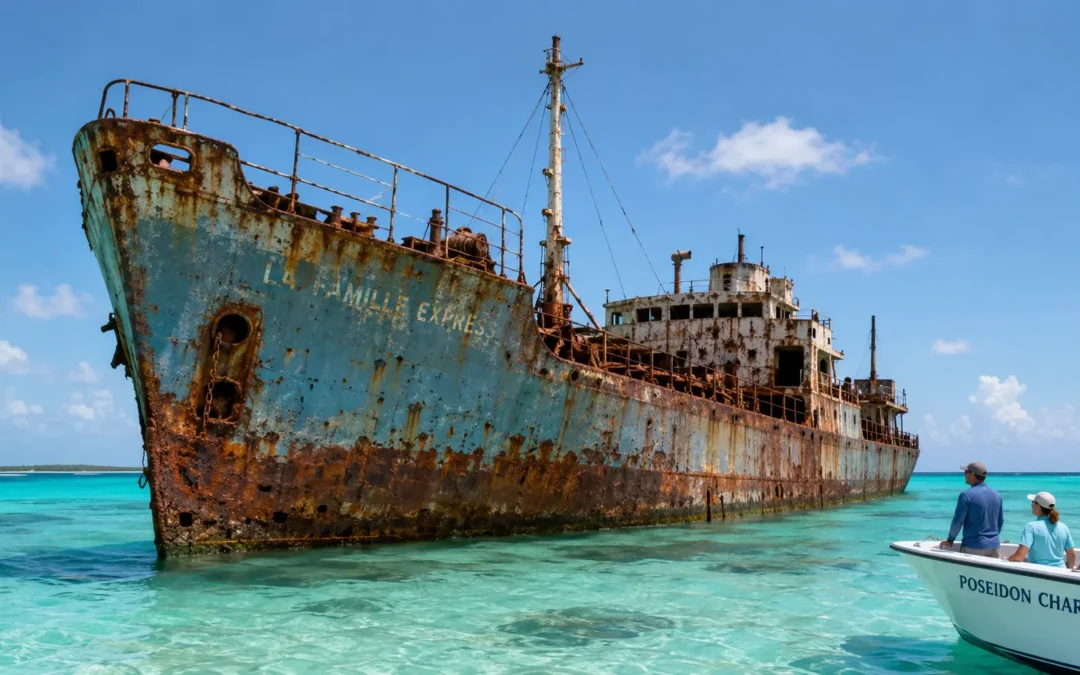
A rusting cargo ship sitting in a few feet of clear turquoise water looks like something staged for a photo, but the La Famille Express is real, and its story explains why it ended up exactly where it sits today. This guide covers where the vessel came from, how it got here, where to find it, what is actually safe to do around it now, and how it fits into a private charter day.
From Working Vessel to Turks and Caicos Landmark
The Vessel Before Turks and Caicos
Long before it became a Providenciales landmark, the ship worked as a Soviet-era vessel built in the early 1950s, originally serving offshore oil operations under the name Fort Shevchenko. Decades of use followed, including service through periods of real geopolitical tension in the region’s history. Eventually the vessel changed ownership and flag, and by the late 1990s it operated under the name La Famille Express, working as a regional freighter hauling bulk cargo around the Caribbean. By the early 2000s, the ship was aging and no longer in prime condition, a detail that matters for what happened next.
Hurricane Frances and the 2004 Grounding
In 2004, Hurricane Frances moved through the region with high winds strong enough to drag the unmanned vessel from its anchorage near South Dock on Providenciales. The ship traveled a remarkable distance, roughly twelve miles, before settling into the shallow water of the Caicos Banks, where it remains today. It never sailed again after that storm. What started as one freighter’s ordinary anchorage during a hurricane ended with a permanent, uninvited landmark just off the island’s south coast. More than two decades later, the wreck is far better known to visitors than it ever was as a working ship.
Where Is La Famille Express?
The wreck sits roughly two miles offshore from Long Bay Beach, on the southeast side of Providenciales, in shallow water on the Caicos Banks. It is visible from a distance on a clear day, but it is genuinely far enough out that swimming to it from the beach is not realistic for almost anyone. This is not a beach attraction in the usual sense. There is no path, no dock, and no way to simply walk up to it. Reaching La Famille Express means getting on the water, whether by charter boat, jet ski tour, or another water-based excursion.
How Do You Visit La Famille Express?
Water access is the only way to reach the wreck, since its location on the Caicos Banks puts it well beyond swimming distance from shore. Most visits happen as one stop within a longer boat trip, often combined with snorkeling or a beach stop elsewhere on the south side of the island. A private charter can time the visit around the day’s conditions and combine it naturally with other stops your group wants to see. Reaching the wreck is the easy part. What you do once you are there matters more, and it deserves more attention than most casual mentions of the site give it. Older photos and social posts sometimes show visitors climbing onto the ship itself, which brings up the next question directly.
Can You Climb Onto La Famille Express?
No. Climbing onto or into the wreck is not something we recommend, and current guidance around the site is clear on this point. The ship has sat exposed to salt water and weather for more than two decades, and that time has taken a real toll on its structure. Rust has eaten through sections of the hull and deck, creating sharp edges throughout the vessel that were not there when it first ran aground. Surfaces that once held weight safely may no longer be stable, and there is no way to tell which parts are still sound just by looking at them.
Older travel content and social media sometimes show people climbing in and jumping off the wreck, and that content should not be treated as current safety guidance. Conditions on a deteriorating structure change over time, not on a fixed schedule anyone can predict. The safest and most current approach is to view and photograph the wreck from the water rather than boarding it, and to follow whatever specific guidance your captain gives on the day, since access and conditions can shift.
What Can You Experience Safely Around the Shipwreck?
View the Wreck From the Water
Approaching by boat and viewing the wreck from the water gives you the full scale of the ship without any of the risk that comes with boarding it. The contrast between the rust-red hull and the turquoise water around it is dramatic enough on its own, and it photographs well from a distance in a way that up-close shots inside the structure cannot match anyway.
Experience the Surrounding Water Only When Conditions and Crew Guidance Permit
Depending on conditions, some charters allow time in the water near the wreck itself, though this should never be assumed or promised in advance. Current, depth, and visibility around the site can change, and a captain’s judgment on the day matters more than any general description. Swimming or snorkeling near the wreck, when conditions genuinely allow it, should always follow your crew’s specific direction rather than assumptions carried over from another trip.
What Makes the Wreck So Photogenic?
Part of the appeal is pure visual contrast. A large rusted hull sitting in shallow, brilliantly clear water creates a scene that looks almost staged, even though nothing about it is. Wide shots that capture the wreck against open sky and turquoise water tend to work better than close-up attempts, especially since a genuine close-up would mean getting closer than is currently advisable. The history adds another layer once you know it, turning what could be just an odd-looking object into a real story about a hurricane, a freighter, and more than two decades of exposure to salt water and sun.
Should the Shipwreck Be the Whole Charter?
Usually not, and that is worth saying plainly. Viewing the wreck itself does not take very long once you arrive, so building an entire charter around it alone tends to leave time unused. It works far better as one stop within a broader day, paired with snorkeling, a beach stop, or general sightseeing along the south side of the island. Whether the wreck fits into a particular day’s route depends on conditions and distance from wherever else your charter is headed, so treat it as a strong possible addition rather than a fixed promise. Poseidon lists the shipwreck among the specialties guests can ask about when planning a half-day charter, alongside snorkeling and island stops, rather than as a separate booked product on its own.
How Conditions Affect Whether the Wreck Fits Your Day
Wind, sea state, and visibility all affect whether a stop at the wreck makes sense on a given day, and your captain is the one actually qualified to make that call in the moment. A calm, clear day makes for better photos and easier viewing. Rougher conditions might mean skipping the stop entirely in favor of somewhere more sheltered. No operator can guarantee this regardless of how an itinerary reads in advance, and a good crew will tell you honestly rather than force a stop that is not safe that day.
Frequently Asked Questions About La Famille Express
Is La Famille Express still there today?
Yes, still resting in the same shallow water where Hurricane Frances left it in 2004. Its condition keeps deteriorating, which is why climbing onto it is not recommended.
Is the wreck a scuba diving site or a snorkeling site?
Shallow water makes it better suited to viewing from a boat or light snorkeling nearby than a deep scuba dive.
How far is the shipwreck from Providenciales?
Roughly two miles offshore from Long Bay Beach, well beyond swimming range, so reaching it means getting on a boat.
What should you bring for a shipwreck stop?
A phone or camera in a waterproof case, plus the usual sun protection and water for the rest of the charter day.
See a Famous Turks and Caicos Shipwreck With a Local Crew
The story behind La Famille Express is better experienced in person than described in any article, viewed safely from the water with a crew who knows current conditions. Ask about including a shipwreck stop when you book a half-day charter with Poseidon, and your captain can work it into a route that also covers snorkeling or a beach stop.
