
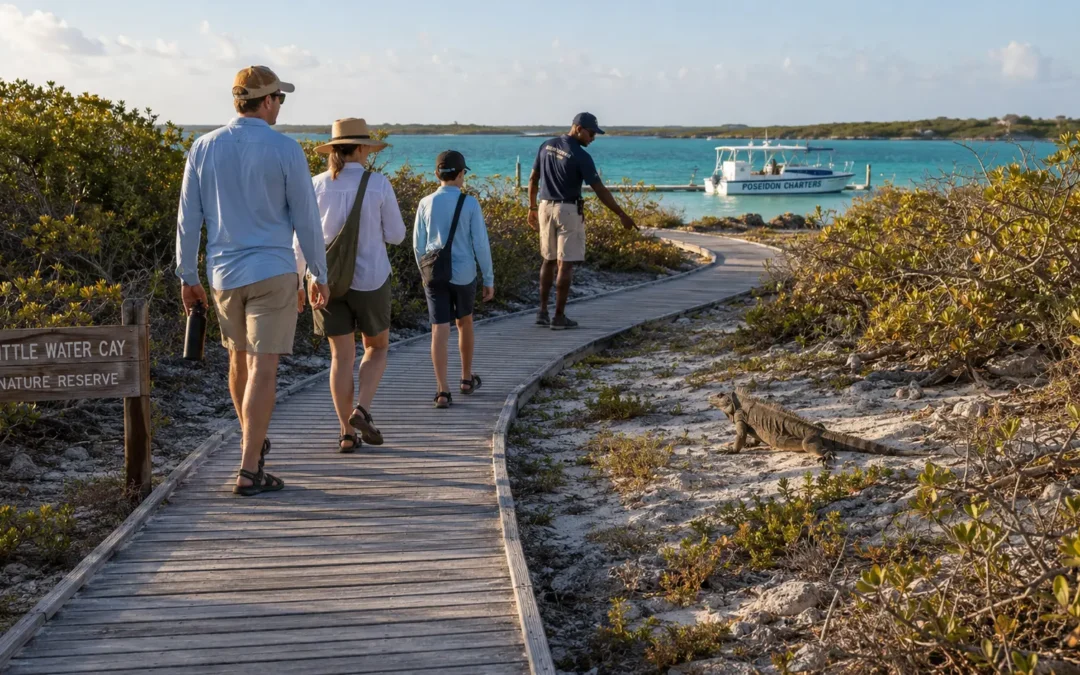
Ask five people about Iguana Island in Turks and Caicos and you will likely get five slightly different directions, because the name is not official and everyone means something close to the same place, but not exactly. This guide clears that up first, then covers what makes the real Iguana Island worth visiting, how to see the rock iguanas responsibly, how to actually get there, and what else to pair with the stop.
First, Which Iguana Island Are You Looking For?
The island almost everyone means when they say Iguana Island is Little Water Cay, a small cay just off Providenciales that protects a population of native rock iguanas. It is the destination shown in most tour listings, most photos, and most local recommendations. The name Iguana Island is not official. It is a nickname that stuck because it describes the experience better than the cay’s actual name does. Confusion sometimes comes from other loosely similar names used across different tours and websites, so it is worth confirming with any operator that Little Water Cay is specifically the destination before booking, especially if a listing only says Iguana Island without naming the cay directly.
Why Little Water Cay Is More Than a Tourist Stop
The Turks and Caicos Rock Iguana
The Turks and Caicos rock iguana is endemic to this island chain, meaning it exists naturally nowhere else on earth. The species has lost most of its historic range to development and introduced predators on the larger, inhabited islands, which makes protected cays like Little Water Cay genuinely important, not just a pleasant backdrop for photos. Seeing one here means seeing a species that depends on exactly this kind of protected habitat to survive at all.
A Protected Island Environment
Little Water Cay sits within the Princess Alexandra Nature Reserve, a protected area established to preserve habitat across this part of the Caicos Cays. That status is why the island has managed walking trails instead of open access everywhere, and why visitor behavior on the ground actually matters to the reserve’s long-term health. Visiting here is closer to a nature reserve visit than a beach stop, even though the beaches nearby are excellent too.
What Is It Like to Visit Iguana Island?
Boats typically anchor offshore and bring visitors in for a walk along low boardwalks and sandy trails that loop through the scrub interior of the cay. The landscape itself is worth slowing down for, with low vegetation, bright sand, and water clear enough to see through the trees before you even reach the shoreline. Iguanas often appear along the trail on their own, since they are used to a level of human presence here that they are not anywhere else in the islands. How many you see, and how close they come, varies by visit and time of day, so treat any sighting as a genuine highlight rather than something guaranteed. Most visits last somewhere between twenty minutes and an hour, often paired with time back on the boat or a nearby beach stop.
How to See the Rock Iguanas Without Harming Their Habitat
Do not chase or corner an iguana to get a closer photo. They will often approach on their own if you stay still and patient. Do not pick up or handle an iguana under any circumstances, even if it seems calm, since handling causes real stress to a wild animal. Never feed them, including fruit or anything that seems harmless, since human food can genuinely harm their health and changes natural behavior in ways that hurt the population over time. Stay on marked trails rather than cutting through vegetation, since the scrub habitat itself supports the population beyond just the sand you can see.
Keep noise reasonably low and movements slow, since sudden motion and loud groups tend to push iguanas away from the trail rather than toward it. Follow your captain or guide’s direction on the day, since local knowledge of the reserve’s current rules matters more than general guidance.
How to Visit Iguana Island From Providenciales
Little Water Cay sits close enough to Providenciales that it works naturally as part of a half-day or full-day charter, rather than requiring a dedicated trip on its own. Most Little Water Cay boat tours combine the stop with snorkeling, another nearby cay, or beach time, since the visit itself typically runs well under an hour. A private charter lets you set how much time to spend on the trail versus other stops, while a shared tour follows a fixed schedule set in advance. Either way, access is by boat only, since there is no bridge or public ferry connecting the cay to Providenciales. Anyone searching for how to visit Iguana Island is really asking how to get onto a boat headed toward Little Water Cay specifically, not a separate booking process of its own.
Don’t Make Iguana Island Your Only Stop, Build a Better Caicos Cays Route
Little Water Cay works best as one stop in a longer Caicos Cays route, not the entire trip.
Pair It With Half Moon Bay
Half Moon Bay sits close by and adds real beach and swimming time that Little Water Cay’s trail experience does not really offer on its own. Visiting both in the same trip covers wildlife and beach relaxation without adding much extra travel between stops, since the two cays sit right next to each other in the chain.
Add Water Cay
Water Cay extends the same stretch of shoreline further along and gives another quiet beach option without adding much travel time to the route. It works well as a short third stop rather than a destination that needs its own dedicated trip.
Include Snorkeling When Conditions Allow
If visibility and current cooperate that day, a nearby snorkeling stop rounds out a Caicos Cays route with an active element beyond walking trails and beach time. Whether this happens depends entirely on conditions, so treat it as a possible addition rather than a guarantee.
Is a Half-Day Enough for Iguana Island?
A half-day charter works well when Little Water Cay is one of two or three planned stops, especially when paired with a nearby cay and some snorkeling. Poseidon’s half-day private yacht charter fits this pattern naturally, since the trail visit itself does not take long and leaves plenty of time for the rest of the day. A full day makes more sense for a group that wants to range further across the Caicos Cays, adding a stop like Pine Cay or a longer snorkeling session without feeling rushed anywhere. For most visitors whose main goal is seeing the iguanas properly and enjoying a beach stop alongside it, a half-day gives enough time without paying for hours you will not use.
Who Will Enjoy This Stop Most?
Wildlife lovers get the clearest payoff here, since few places let you walk this close to a genuinely rare species in its natural habitat. Families tend to enjoy it too, since the walking pace is easy and the iguanas are a reliable source of excitement for kids. Photographers benefit from the combination of wildlife, clear water, and open sky. First-time visitors to Turks and Caicos often list it among the most memorable stops of the whole trip.
Frequently Asked Questions About Iguana Island
Are the rock iguanas dangerous, or will they bite?
Not under normal circumstances, since they are herbivores and not aggressive. Like any wild animal, they can bite if handled or cornered, so keep a respectful distance.
Can you see the iguanas without booking a boat tour?
Not really. There is no bridge or public ferry, so a boat, whether your own or a charter, is the only way in.
Is Little Water Cay the only place to see Turks and Caicos rock iguanas?
It is the most reliable and accessible one. A few other remote, predator-free cays hold smaller populations, but they are far harder to reach.
What is the best time of day to visit for the best chance of seeing iguanas?
Morning or late afternoon, when it is cooler and iguanas tend to be more active along the trails.
Explore Little Water Cay and the Caicos Cays by Private Yacht
Seeing the rock iguanas properly takes less time than most people expect, which leaves room to build a fuller day around it. Explore Poseidon’s half-day private yacht charter to combine Little Water Cay with a beach stop and snorkeling, all set at your group’s own pace.